

This is 2048 unblocked: the full game loads straight from 2048.my in your browser, so you can play 2048 online free on a school Chromebook, a laptop or a phone with no download and no sign-up.
2048: why one simple rule keeps people playing
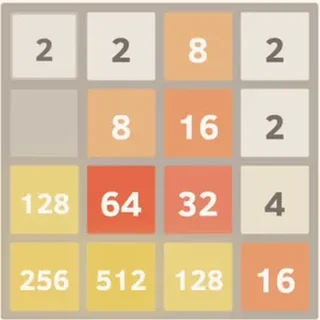
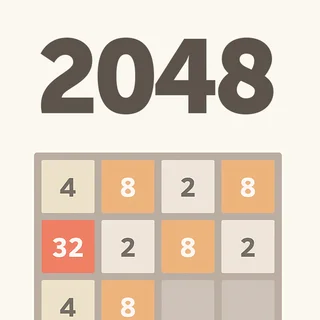
2048 fits on a single screen and explains itself in one sentence: join the numbers and get to the 2048 tile. The board is a 4 by 4 grid. Each turn you push every tile up, down, left or right as far as it will go. When two tiles with the same number run into each other, they become one tile with double the value — two 2s make a 4, two 4s make an 8 — and a fresh 2 or 4 drops into a random empty square.
That last part is what makes it a puzzle rather than a toy. Every move adds a tile, but only merges take tiles away, so the board fills up unless you plan. A good position keeps the big numbers together and in order, usually packed into one corner, so that each new merge can chain into the next. A bad one scatters a 64 here and a 128 there with small tiles stuck between them, and the game ends when no move can change the board.
The version on this page is Gabriele Cirulli's own code, the open-source release that started the craze in March 2014, served straight from this domain with nothing added. It remembers your best score and even the board you were in the middle of, so you can close the tab and pick the game up later on the same browser.
Controls & mechanics
| Action | Control | Purpose |
|---|---|---|
| Slide tiles | Arrow keys, W A S D or H J K L | Every tile moves as far as it can in that direction |
| Merge | Push two equal tiles together | They become one tile worth their sum; the sum is added to your score |
| New game | R or the New Game button | Clears the board; your best score is kept |
| Touch | Swipe on the board | Works on phones, tablets and touch-screen Chromebooks |
| After 2048 | Keep going | Carry on towards 4096 and beyond instead of stopping at the win screen |
| Game over | Try again | Appears when the board is full and no merge is possible |
Playing 2048 well
- Choose a corner and stay there: Keep your biggest tile in one corner and build the rest of the board down from it.
- Use mostly two directions: If the big tile lives bottom-left, press left and down most of the time. Right is the backup; up is the last resort.
- Keep the edge row full: A full bottom row cannot slide sideways, so the corner tile cannot be pushed out of place.
- Merge towards the big tile: Line numbers up in order — 256, 128, 64, 32 — so one merge sets off the next.
- Count empty squares: Before each move, ask which direction leaves the most free space. Space is your real resource.
- Slow down at the end: Most games are lost in the last few moves before a big merge. There is no timer, so think.
Key features
- The original code: Gabriele Cirulli's own open-source 2048, not a remake.
- Board saved: Your current game and best score are kept in the browser between visits.
- Keyboard or touch: Arrows, WASD, Vim keys or swipes.
- Play past 2048: Keep going to chase 4096, 8192 and higher.
- No timer: Every move can take as long as you like.
- Light and fast: A few small files; it runs on any school laptop or phone.
Game info
- Title: 2048
- Developer: Gabriele Cirulli
- Category: 2048 & Number Puzzles
- Platform: Web browser (HTML5)
- Build: Gabriele Cirulli · 2014 · MIT-licensed original code served from 2048.my
Pro tip: When you are stuck choosing, pick the move that keeps your biggest tile in its corner — even if another move merges something.