The Maths of 2048: Scores, Odds and How Many Moves It Takes
Published · 3 min read
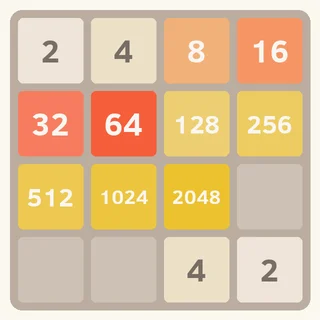
2048 looks like a game about numbers, but it is really a game about counting space. Still, the numbers have some neat properties, and knowing them explains a lot about how a game goes. Everything below comes from how the original code works.
Where new tiles come from
After every move that changes the board, the game picks a random empty square and puts a new tile in it. The tile is a 2 nine times out of ten and a 4 one time out of ten. The game begins with two of these tiles already placed. Nothing else ever adds to the board — no bonus tiles, no blockers.
How the score works
Your score only goes up when tiles merge, and it goes up by the value of the tile you just made. Join two 2s and you get 4 points. Join two 1024s and you get 2048 points. Sliding without merging scores nothing.
That rule means building a big tile also builds a predictable score. If every new tile were a 2, a 4 would be worth 4 points of merging, an 8 would be worth 16 (two 4s at 4 each, plus 8 for the final merge), a 16 would be worth 48, and so on. The pattern is simple: a tile of value 2n built from 2s has earned (n − 1) × 2n points along the way. For 2048, which is 211, that is 10 × 2048 = 20,480 points.
In real games, some of the tiles arrive as free 4s, and a free 4 skips a 4-point merge. So a game that ends with a single 2048 tile and little else usually shows a score a little under 20,000. If your score at the win screen is far above that, you also had plenty of other big tiles on the board.
How many moves does a win take?
Merging never changes the total of all the numbers on the board — two 64s become one 128, and the sum stays the same. The only thing that raises the total is the new tile after each move. So to have at least 2048 on the board, the new tiles must add up to about 2048.
An average new tile is worth 2.2 (nine 2s and one 4 in every ten). 2048 divided by 2.2 is about 930. That is the rough minimum number of moves for a win, and in practice it takes somewhat more, because some moves are spent fixing the board. If you have ever wondered why a winning game takes a while, that is why: close to a thousand presses, every one of them a decision.
Why the corner strategy works, in numbers
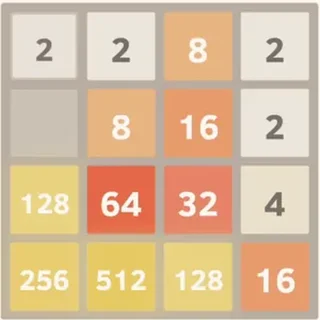
The board has 16 squares. To build a 2048 tile you need, at some point, a 1024, a 512, a 256, a 128 and so on down the line, all waiting for the next piece. That chain alone can take eight or nine squares. If those tiles are scattered, merges cannot reach each other and the free space disappears. Keeping them in a snake along one edge, biggest in the corner, means each merge at the small end can roll all the way up. The maths does not force the corner — it just makes everything else much harder.
The biggest tile you could ever make
A 4x4 board has 16 squares. In the best possible case, the board could hold a chain of tiles 4, 8, 16 and so on up to 65536, with one square left over. If the last empty square then receives a 4 at the perfect moment, the whole chain can merge, all the way to 131072. That is the theoretical maximum for this board size. Because it depends on the 10 percent chance of a 4 arriving at exactly the right time, 65536 is the realistic ceiling, and even that is reached only by the most patient players.
What this means when you play
- Your score tracks your biggest tiles. Chasing points and chasing big tiles are the same thing.
- Every move costs space. A move that merges nothing still adds a tile. Make them count.
- A 4 is a gift early and a risk late. It skips a step, but in a crowded corner it can land where a 2 would have merged.
- Close to a thousand moves to win. Patience is part of the game.
More from the blog
- Where 2048 Came From: Threes!, 1024 and a Weekend in 2014
The short story of 2048: the games that came before it, the weekend it was written, why it spread so fast and what open source meant for every copy.